
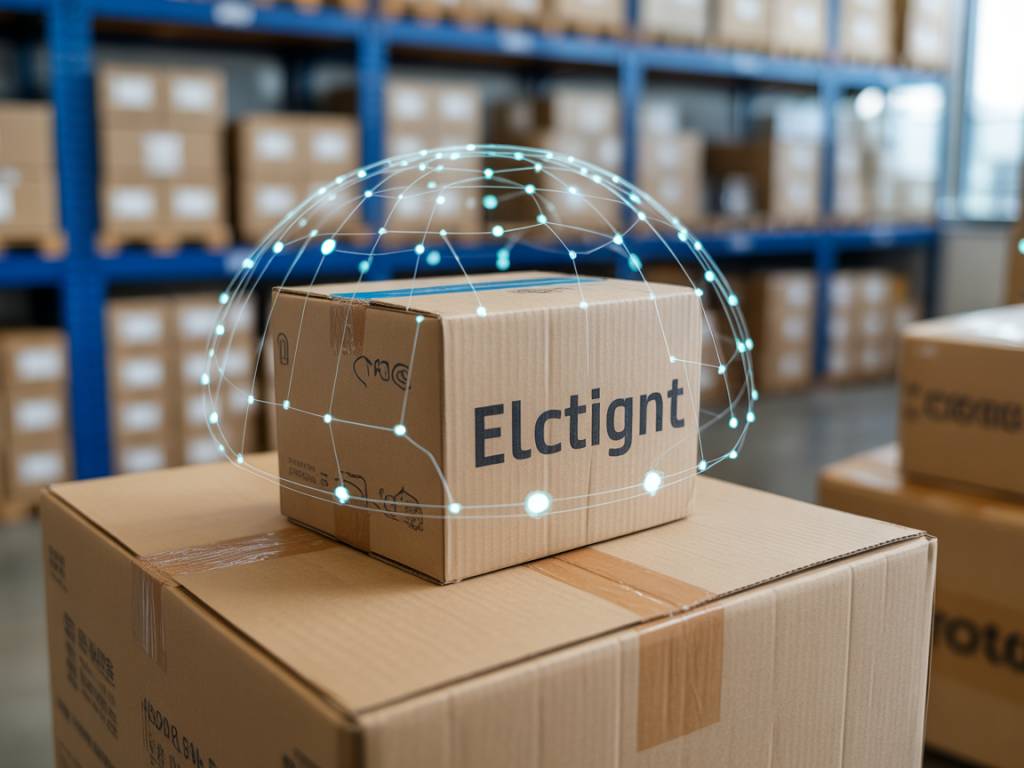
L’essor du packaging intelligent connecté à l’IoT : comment transformer vos emballages en sources de données pour la chaîne logistique
Understanding connected smart packaging and the Internet of Things
Connected smart packaging refers to any packaging solution that integrates digital technologies and communicates data through the Internet of Things (IoT). More than just a protective layer, the package becomes a connected object equipped with identifiers, sensors, and communication modules capable of generating and transmitting real-time data across the supply chain.
In logistics and supply chain management, smart packaging connected to IoT enables companies to monitor products continuously, from production lines and warehouses to transport and last-mile delivery. By transforming packaging into data sources, manufacturers, brand owners, logistics service providers, and retailers can optimize traceability, reduce losses, and improve customer experience.
Typical technologies used in intelligent packaging include RFID tags, NFC chips, QR codes, barcodes, Bluetooth Low Energy (BLE) beacons, and embedded sensors (temperature, humidity, shock, tilt, location). Combined with cloud platforms and supply chain software, these devices feed end-to-end visibility and advanced analytics.
Key technologies enabling IoT-connected packaging
Several complementary technologies support the development of smart and connected packaging for logistics. Each one offers different levels of data richness, range, and cost.
Among the most common enablers are:
- RFID (Radio Frequency Identification): Passive or active tags that communicate with readers to provide unique identification and, in some cases, additional data. Ideal for high-speed scanning at warehouse gates and automated inventory management.
- NFC (Near Field Communication): Short-range technology integrated into labels, cards, or caps, often used for consumer engagement and product authentication. It can also support logistics operations via handheld devices.
- QR codes and 2D barcodes: Printed codes that store more information than traditional barcodes. They require visual line-of-sight scanning but are inexpensive and easy to deploy at scale.
- BLE beacons and trackers: Small IoT devices that broadcast signals to nearby gateways or smartphones. They enable real-time location tracking of pallets, containers, and high-value items in warehouses or during transport.
- Embedded sensors: Temperature, humidity, shock, vibration, light exposure, or tilt sensors integrated into packaging, pallets, crates, or reusable containers. They provide condition monitoring to protect sensitive products.
- Cellular and LPWAN (NB-IoT, LTE-M, LoRaWAN): Connectivity options for long-range tracking, enabling continuous data transmission across national or global transport networks.
When combined with analytics platforms, warehouse management systems (WMS), transportation management systems (TMS), and ERP software, these technologies turn packaging into active data nodes within the broader IoT ecosystem of the supply chain.
From protective layer to data source for the supply chain
Traditional packaging focuses on protection, branding, and compliance. Connected smart packaging adds a new strategic dimension: data generation. Each unit, case, pallet, or container becomes an information carrier that feeds logistics processes in real time.
Examples of data that can be collected from connected packaging include:
- Unique product or batch identification and serialized tracking
- Time and location of each scan, transfer, or checkpoint
- Temperature and humidity levels during storage and transport
- Shock and vibration events indicating mishandling or damage risk
- Light exposure, useful for certain chemicals, cosmetics, or pharmaceuticals
- Opening or tampering detection for high-value or regulated products
By centralizing this information in a cloud platform, supply chain managers can monitor flows end-to-end, detect anomalies earlier, and correlate packaging data with inventory, demand, and operational performance indicators.
Benefits of IoT-connected smart packaging for logistics
For logistics and supply chain professionals, connected packaging is not just a technological trend but a performance lever. The main benefits include:
- Enhanced traceability and compliance: Real-time visibility of product location and status supports regulatory requirements in sectors such as pharmaceuticals, food and beverage, and chemicals. Serialized identification and automated data capture reduce errors linked to manual scanning.
- Reduced losses, waste, and shrinkage: Condition monitoring of temperature-sensitive or fragile goods helps identify where and when the cold chain was broken or a product was mishandled. This enables targeted corrective actions and limits overall product waste.
- Optimized inventory and warehouse operations: RFID or barcode-enabled packaging accelerates counting, receiving, and picking operations. Data from connected packaging feeds more accurate inventory levels and helps prevent stockouts or overstocking.
- Improved transport efficiency: Location and condition data from pallets, containers, and load carriers allow better planning of routes, consolidation of shipments, and performance monitoring of carriers and partners.
- Stronger customer and end-user experience: Data stored or accessed via QR codes or NFC labels can provide consumers and B2B customers with product origin, authenticity, usage, and recycling information. In B2B contexts, clients may access real-time delivery status and temperature logs.
- Data-driven decision-making: Historical and real-time data generated by intelligent packaging can feed predictive models for demand forecasting, maintenance of reusable packaging, and optimization of packaging design itself.
Strategic use cases in different industries
Connected smart packaging and IoT can be implemented across a wide range of sectors, each with their own priorities and regulatory constraints.
- Food and beverage: Smart labels with temperature and time indicators for fresh and frozen products; RFID cases to track batches during distribution; QR codes to inform consumers about origin, allergens, and sustainability. Cold chain monitoring is a core application.
- Pharmaceuticals and healthcare: Serialized packaging combined with RFID and tamper-evident seals for anti-counterfeiting and regulatory traceability; temperature and shock monitoring for vaccines and biopharmaceuticals; connected secondary packaging for hospital inventory management.
- Cosmetics and luxury goods: NFC-enabled packaging for product authentication and personalized digital content; connected caps and tags for anti-theft protection; traceability of high-value shipments via BLE or cellular trackers.
- Industrial and automotive: Reusable containers, pallets, and metal racks equipped with IoT trackers; condition monitoring during cross-docking and long-distance transport; automated inventory and container pool management across multiple sites.
- E-commerce and retail: Parcel tracking with smart labels; last-mile monitoring for sensitive products; integration of packaging data into omnichannel logistics systems; consumer-facing codes for returns, recycling instructions, and loyalty programs.
Across these industries, smart packaging connected to IoT reinforces the link between physical flows and digital information flows, helping to create more resilient and transparent supply chains.
How to implement IoT-connected smart packaging in your supply chain
Deploying intelligent packaging solutions requires a structured approach that involves packaging engineers, logistics teams, IT departments, and external partners. A typical roadmap may include the following steps:
- Define business objectives and KPIs: Clarify whether the priority is traceability, waste reduction, compliance, customer experience, or a combination. Identify key performance indicators such as spoilage rate, inventory accuracy, on-time delivery, or temperature excursion frequency.
- Select target product ranges and flows: Start with high-value, high-risk, or highly regulated products where the ROI from connected packaging is easiest to demonstrate. Map the critical control points of the supply chain (production, storage, transfer, delivery).
- Choose appropriate technologies: Based on range, environment, volume, and cost constraints, select the combination of identifiers (RFID, QR, NFC) and sensors (temperature, shock, etc.) that best fits the use case. Consider whether packaging will be single-use or reusable.
- Integrate data with existing systems: Ensure that data from connected packaging can be collected by gateways or readers and integrated into WMS, TMS, ERP, or a dedicated IoT platform. This integration is crucial to provide operational insights rather than isolated data.
- Pilot projects and scaling: Test smart packaging on a limited scope, refine processes, train staff, and measure performance. Once the pilot validates the expected benefits, gradually extend deployment across more products, sites, and partners.
- Collaborate with packaging and technology suppliers: Work closely with packaging manufacturers, label printers, IoT device vendors, and integrators to co-design solutions adapted to your packaging lines and logistics constraints.
Challenges and points of attention
Despite its potential, the deployment of IoT-connected smart packaging raises practical challenges that logistics and packaging professionals must anticipate.
- Cost and ROI: Adding sensors, tags, or connectivity increases the unit cost of packaging. The financial model must take into account the reduction in waste, improved operational efficiency, and potential revenue or service benefits.
- Data management and interoperability: The volume of data generated can be significant. Companies need robust IoT platforms, data governance policies, and standards (such as GS1) to ensure interoperability along multi-actor supply chains.
- Durability and recyclability: Adding electronic components to packaging can complicate recycling and end-of-life management. Ecodesign principles and modular approaches (e.g., reusable IoT devices attached to standard packaging) are important considerations.
- Battery life and maintenance: For active devices and sensors, battery life, recharging, and maintenance cycles must be compatible with logistics operations. Reusable crates or pallets equipped with IoT modules require a maintenance plan.
- Data security and privacy: Connected packaging can reveal sensitive information on volumes, routes, or inventories. Cybersecurity measures and access management are essential, particularly when involving external logistics partners and customers.
- Change management: Operators, warehouse teams, and carriers need training on how to handle, read, and interpret connected packaging. Process adaptation is just as important as technical integration.
Future trends in smart and connected packaging for logistics
The development of smart packaging connected to the IoT is accelerated by several technological and market trends. For supply chain stakeholders, these evolutions will further transform packaging into a strategic data asset.
- More affordable and flexible sensors: Printed electronics, low-cost temperature indicators, and battery-free sensors will make it easier to equip a larger share of packaging at unit level, not just at pallet or container level.
- Edge computing at the packaging level: Some advanced devices will be able to pre-process data locally (e.g., only send alerts when thresholds are exceeded), reducing connectivity costs and bandwidth usage.
- Standardization of data models: Industry alliances and standards organizations are working on common data formats and identifiers, enabling seamless exchange of packaging data across ecosystems.
- Integration with sustainability and circular logistics: Smart reusable packaging pools, connected reverse logistics for returns, and digital passports for products and materials will support circular supply chain models.
- AI-driven analytics: Machine learning applied to packaging data will help predict failures in cold chains, optimize inventory positioning, detect anomalies in transit patterns, and recommend packaging design improvements.
- Closer link between consumer engagement and logistics: The same smart code or tag on the package will support track-and-trace for logistics teams and digital services for consumers, bridging marketing, customer care, and supply chain data.
For logistics, operations, and packaging professionals, investing in IoT-connected smart packaging is increasingly a way to differentiate, secure flows, and build more resilient supply chain networks. By carefully selecting use cases, technologies, and partners, companies can turn their packaging from a cost center into a continuous source of actionable data.
 Enhancing Packaging Sustainability Through Circular Economy Practices
  Smart Packaging Technologies: Bridging the Gap Between Product Safety and Supply Chain Efficiency
  Sustainable packaging innovations transforming logistics operations
  L’essor du packaging intelligent connecté à l’IoT : comment transformer vos emballages en sources de données pour la chaîne logistique
  Leveraging Digital Twin Technology to Optimize End-to-End Supply Chain Visibility
  Optimizing Cold Chain Logistics with Smart Packaging Solutions